
Board Size
Challenge
Currently, the Board has 18 members, which is large compared to most association Boards and doesn’t align with leading practices. A large Board hinders effective participation and discussion and debate of key issues, leading to slower decision-making.

Opportunity
Create a smaller, more nimble Board. Studies and leading practices have shown that smaller groups are better strategic decision-makers.
This proposal is the same as was made in 2025. In member comments after the Bylaw vote, members expressed comfort with the Board size reduction. The 2026 member survey showed strong support for a 12-member Board.

Proposal
Reduce the size of the Board from 18 to 12 members. A smaller Board will foster in-depth discussion and rigorous debate, allowing the SOA to more rapidly address emerging opportunities and challenges for the organization and the profession.
Board size will reduce from 18 to 12 members over a 4-year period. The 2026-2027 Board will still have 18 members; the first Board with 12 members will be the 2029-2030 Board.
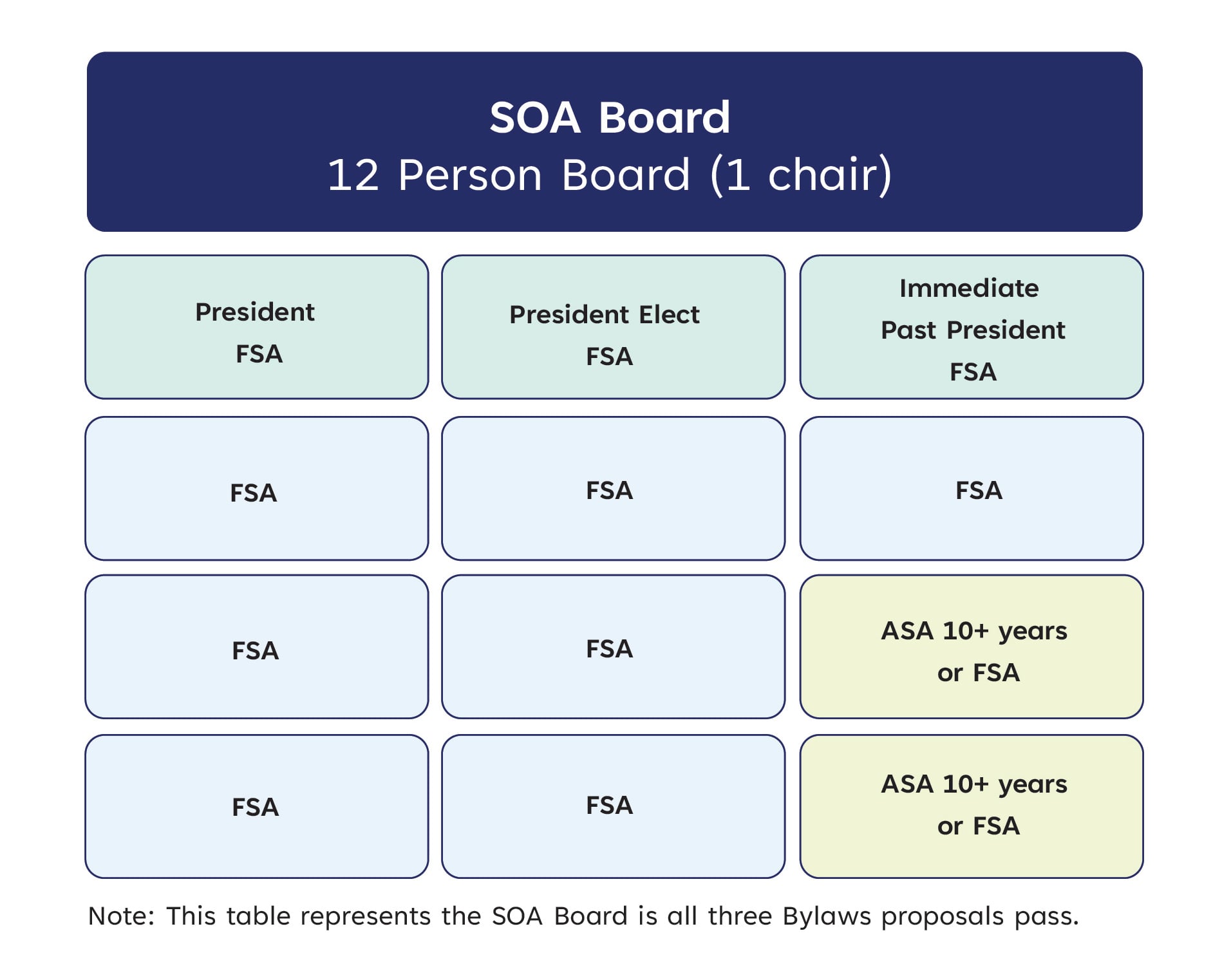
The Governance Review Task Force chose 12 members for several reasons. First, there is a need to maintain a three-year term for the President, so there will always be three presidential officers on the Board (President Elect, President, and Past President). Second, this structure allows for the inclusion of ASAs who have been members for 10 years or more. Third, a majority of the Board should consist of regular Board members (and not presidential officers or the Board Chair). To keep everyone on three-year terms, having 12 members strikes a balance between the desire for a smaller Board and the need to bring in diverse perspectives. There could be a fluctuation of 10-13 as the exact number in any given year would depend on strategic needs and availability of qualified candidates to fill designated seats.
When we surveyed members in 2026, we tested member preferences for Board size; members preferred a 12-person Board over the other options presented (a 9-, 12-, 15- or 18-person Board).
No. Board diversity depends more on more on the strength of the candidate recruitment, assessment and selection processes than on the number of Board seats. Diversity can be achieved in many ways, and a larger Board does not ensure it. For example, the current Board does not fully reflect the diversity of our membership. There are also no ASAs who have been members for 10 years or more on the Board, but career ASAs make up about a third of our membership while ASAs of 10 years or more represent 14%. Strengthening candidate recruitment, broadening outreach, improving candidate assessment, and providing members with better information about candidates and needs of the Board are expected to have a greater impact on Board diversity than maintaining a larger Board.